



Most Baton Rouge homeowners get one tree removal quote and call it done. That’s how a $400 job becomes a $1,400 job, or how a legitimate $1,800 crane removal gets dropped for a $600 quote from a guy who shows up Saturday with no workers’ comp. The cost question for a single residential tree in East Baton Rouge Parish has a real answer, and it’s not the national average.
American Forestry Services has been pricing tree removal across Walker, Baton Rouge, Denham Springs, and Livingston Parish for two generations. The Baton Rouge market sits above the national average for one specific reason, old-growth live oaks, hurricane work, and access constraints that don’t show up in the Forbes Home explainer. Here’s what the math actually looks like in 2026.
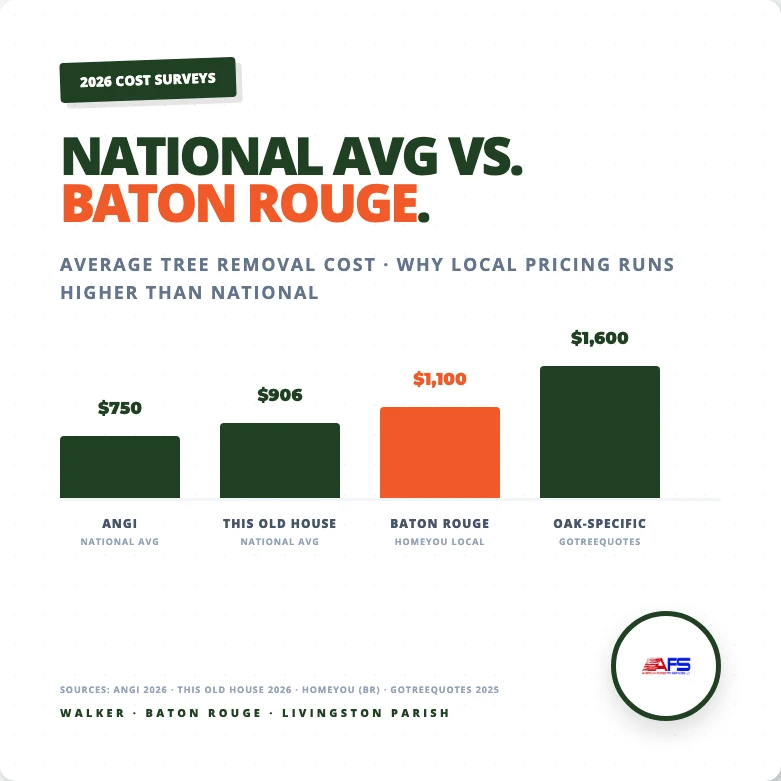
Tree removal cost in Baton Rouge averages around $1,100 with a typical range of $400 to $1,900, per the most recent local cost data from Homeyou’s Baton Rouge tree service cost survey. Emergency and storm-response work averages $821. A live oak over a structure, a crane-required removal, or a post-hurricane uprooted tree can push a single job past $3,000, and complex crane work runs $6,000-$7,000 per Angi’s 2026 tree removal cost data. The right number for your tree depends on height, species, access, and condition, which is why an on-site estimate beats a phone quote every time.
TLDR:
- The Baton Rouge tree removal average is $1,100 ($400-$1,900 typical), running higher than the Angi 2026 national average of ~$750 because the local market is heavier on live oaks, mature canopy, and post-storm work.
- Oak-specific removals average $1,600 with a $350-$4,500 range and crane jobs at $2,000-$5,000+ per GoTreeQuotes 2025 oak tree removal cost analysis, the kind of old-growth live oaks lining Spanish Town and the Garden District are nearly always at the upper end.
- Tree workers face a fatality rate of roughly 110 per 100,000, about 30 times the all-industry average of 3.3 per TCIA’s 2024 safety analysis using BLS Census of Fatal Occupational Injuries data. That’s why a licensed crew costs $1,200 when the door-knocker quotes $300.
- Most homeowner’s policies cap tree removal at $500-$1,000 per tree, often inside a 5% of dwelling coverage limit and a $2,500-$5,000 aggregate, per MoneyGeek’s storm tree removal coverage explainer, and pure preventive removal of a healthy tree is rarely covered at all.
- Anyone doing fee-based tree work in Louisiana must hold a current LDAF Horticulture Commission arborist license. Verify the license before signing anything. It’s a one-minute call to the state.
What’s the Actual Cost Range in Baton Rouge? (Real 2026 Numbers)
Three published 2026 cost surveys frame the picture. HomeGuide’s national tree removal cost guide pegs the U.S. average between $400 and $1,200 with complex jobs reaching $3,000. Angi’s 2026 data puts the national average at roughly $750 with a $200-$2,000+ range. This Old House’s 2026 research lands at $906 average with a typical band of $820-$992 and emergency jobs up to $5,000.
The Baton Rouge market sits above all three. Homeyou’s local cost data shows a Baton Rouge average closer to $1,100 with a typical range of $400-$1,900, emergency work averaging $821, and a working three-person crew rate of $200-$260 per hour. Once you isolate oak removals, and most of the mature canopy in older Baton Rouge neighborhoods is live oak, the oak-specific 2025 average jumps to $1,600 with a $350-$4,500 range.
Two things move a single Baton Rouge job from the $400 end of that range to the $1,900 end (or beyond): the tree itself, and the property around it.
What Changes the Price?
The short list of variables in a Baton Rouge tree removal quote: tree height, trunk diameter at breast height (DBH), species, condition (alive vs. dead vs. decayed), proximity to structures and power lines, access to the drop zone, crane requirements, debris haul-off, stump grinding, and emergency vs scheduled timing. For a deeper look at how each of those variables moves the line items on a quote, see our companion guide on what affects tree removal cost in Walker and Baton Rouge, this post focuses on the dollar math itself.
A few BR-specific notes worth flagging up front. Dead or storm-stressed trees cost more to remove, not less. Climbing a dead tree is categorically less safe than a healthy one, the wood doesn’t behave predictably, and the crew has to slow down and rig from the canopy down rather than working at speed. Access is the second sleeper variable: a backyard tree behind a 40-inch gate with no equipment path costs noticeably more than the same tree in an open front yard, because the crew is hand-hauling material the chipper can’t reach. And in older BR neighborhoods, the access constraint is the rule, not the exception.
Cost by Tree Height (the Single Biggest Variable)
Height is the strongest single predictor of price across every published cost survey. This Old House’s 2026 cost data splits the math into four brackets:
| Tree Height | Typical Cost Range |
|---|---|
| Under 30 ft | $150 – $500 |
| 30 – 60 ft | $400 – $1,000 |
| 60 – 80 ft | $800 – $1,500 |
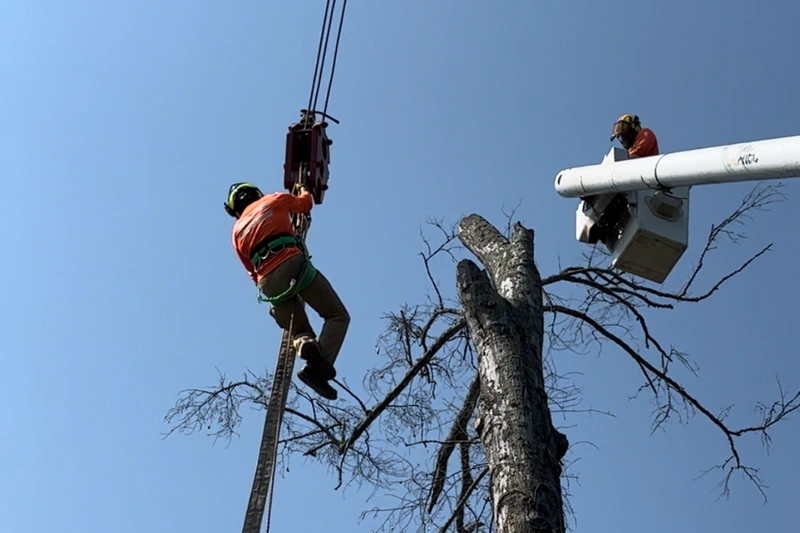
| 80+ ft (crane usually required) | $1,000 – $2,000 base; complex jobs $6,000 – $7,000 |
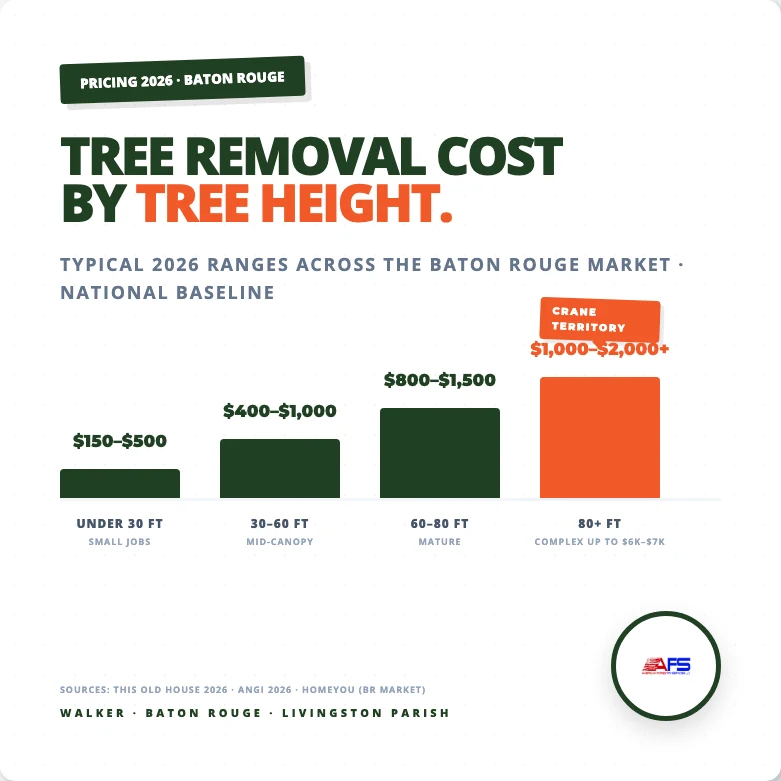
For a Baton Rouge homeowner, the practical takeaway is that any tree taller than the ridge of a two-story house, roughly 25-30 ft, is going to start above the bottom of the second bracket. A mature live oak in a front yard is almost always in the 60-80 ft range. And the 80+ ft category is essentially “you’re getting a crane crew.”
Why Live Oaks Cost More in Baton Rouge
The single most expensive tree to remove in the Baton Rouge market isn’t the tallest pine in Livingston Parish. It’s the mature live oak in the Garden District backyard. There are three reasons for the premium.
First, density. Live oak wood is significantly heavier than most species, which means every cut piece weighs more on the rigging and adds time to the removal sequence. Second, spread: a 200-year-old live oak’s canopy can extend 80 feet sideways, which forces the crew to work the perimeter from a lift or crane rather than climbing and rigging from the trunk. Third, value: LSU AgCenter research on Louisiana live oaks values the 1,200+ live oaks on the LSU campus at roughly $50 million, about $41,000 each, and mature landscape adds an estimated 10-20% to home value. Removing a mature live oak without first confirming it’s irreplaceable is an expensive mistake even before the removal invoice.
The GoTreeQuotes oak-specific 2025 data bears the premium out: $1,600 average versus $750 generic, with crane-required oak jobs running $2,000-$5,000+. In old residential Baton Rouge, Spanish Town, the Garden District, parts of mid-city, the crane scenario is the norm. A separate companion piece covers the permit question for tree removal in Baton Rouge including how the EBR Unified Development Code treats heritage trees; that’s worth confirming before any removal of a mature live oak.
When Insurance Covers Removal (And When It Doesn’t)
The shortest accurate summary of homeowner’s insurance and tree removal: it almost never covers what homeowners think it covers. Per MoneyGeek’s storm tree removal coverage analysis, the typical residential policy caps tree removal at $500-$1,000 per tree, often within a 5% of dwelling coverage limit, with a $2,500-$5,000 aggregate cap on any single claim. The coverage gates on four scenarios:
- A tree falls and damages your insured structure. Usually covered, up to the cap.
- A tree falls on your property with no structure damage. Usually NOT covered. The tree on the lawn is your problem.
- Preventive removal of a dead or dying tree before it falls. Almost never covered. Insurers consider that maintenance.
- A tree from your yard falls on a neighbor’s property. The neighbor’s policy handles their damage; yours is involved only if negligence (a documented dead tree you ignored) comes into play.
Louisiana is a particular case. NOAA’s hurricane impact records show Hurricane Laura alone caused $17.5 billion in damage, the strongest storm to hit the state since 1856. Louisiana Department of Insurance reporting shows carriers paid or reserved $10.6 billion in claims for the 2020 storms through September 2021. The volume drove deductible structures higher and underwriting tighter. Translation: if you’re betting on insurance to cover preventive work, plan to be wrong.
Is Tree Removal Ever Tax-Deductible?
Sometimes, for a narrow set of cases. IRS Publication 547 governs personal casualty losses. Since the 2017 Tax Cuts and Jobs Act, personal casualty loss deductions on a primary residence require the damage to come from a federally declared disaster, so a routine windstorm doesn’t count, but the official designation that follows a major hurricane does. Within that, the personal-casualty deduction is subject to a $100 per-event floor and 10% of adjusted gross income threshold, so it only matters at higher loss amounts.
The most recent Louisiana example: Hurricane Francine made landfall in September 2024 and earned FEMA disaster declaration DR-4817-LA. Removal of trees damaged in a declared event, treated as casualty cleanup, can factor into the casualty calculation. Business and rental property are governed by different rules, the USDA Forest Service guide to timber and tree casualty loss deductions covers those mechanics in detail. If a deduction matters to your tax outcome, this is a CPA conversation, not a contractor one.
Why Licensed Arborists Charge More Than the $300 Yard-Truck Guy
This is the part of the cost question most homeowners don’t ask out loud. When one quote is $300 and another is $1,200 for the same tree, the difference isn’t profit margin. It’s the cost of running a crew that’s allowed to work and trained to survive.
Tree workers face one of the highest occupational fatality rates in the United States. TCIA’s 2024 tree-work safety analysis puts the fatality rate for tree trimmers and pruners at roughly 110 per 100,000 workers, about thirty times the all-industry rate of 3.3 per 100,000 reported by the Bureau of Labor Statistics Census of Fatal Occupational Injuries (5,070 total U.S. fatal work injuries in 2024). Falls and struck-by-object incidents drive most of the count. The two ways a tree service stays out of those numbers are training and equipment, both of which cost money the door-knocker isn’t carrying.
The Louisiana state-level layer adds another filter. Anyone offering fee-based tree work in Louisiana must hold a current arborist license issued by the LDAF Horticulture Commission, which requires a passed exam, current insurance, annual continuing education, and a $125 annual fee. The license is checkable in one phone call. When the quote is suspiciously low, the license usually isn’t there. American Forestry Services has held the LDAF license, BBB accreditation (A+ since September 2024), and current workers’ comp and general liability coverage, and we built the pricing around the actual cost of running a crew that does the work the way the standards require.
What’s Included in a Real Tree Removal Quote (and What’s Not)
A clean residential tree removal quote from a Baton Rouge-area arborist typically separates the line items into three groups: the removal itself, the cleanup, and the stump. The first is the headline number. The second varies (chip on site, haul off the property, leave wood for firewood). The third, stump grinding, is almost always a separate line.
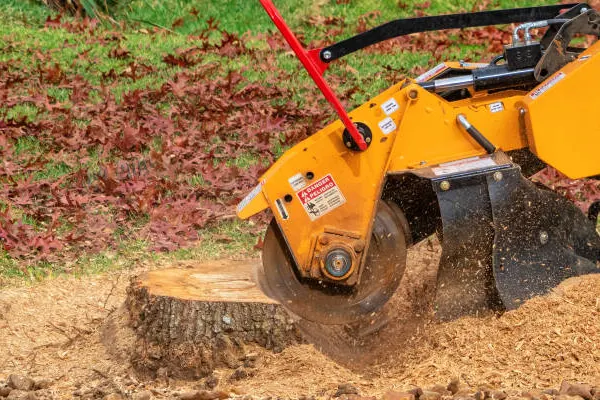
Per Angi’s 2026 stump grinding cost data, stump grinding runs $2-$5 per diameter inch with a $100 minimum and typical job-total range of $150-$500. A 30-inch live oak stump can hit the upper end on its own. Wood chip removal, log hauling, and brush stage-and-haul are commonly itemized. Multi-tree discounts of 10-25% per additional tree are standard when crews can stay on site rather than mobilizing twice.
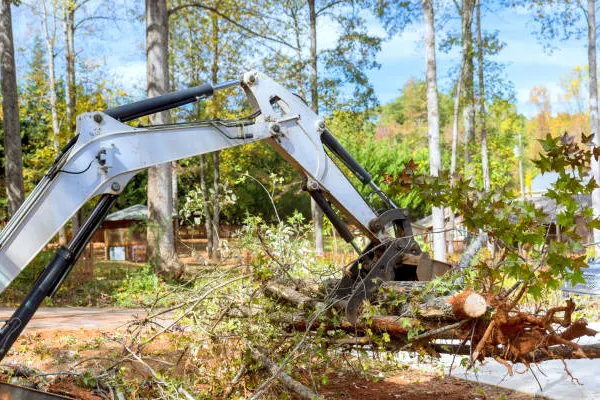
For specialized services that often factor into a Baton Rouge quote, the AFS pages cover the operational details: professional tree removal services, crane services, and debris removal. For the deeper sizing and pricing framework on what makes a single removal more or less expensive, see the companion guide on what affects tree removal cost in Walker and Baton Rouge.
Common Questions About Tree Removal Cost in Baton Rouge
These are the questions Baton Rouge and Livingston Parish homeowners ask before booking. If you’ve gotten two wildly different quotes on the same tree, this section is the read.
What’s the cheapest size tree to remove?
Anything under 30 feet, generally a small pine, dogwood, crape myrtle, or young oak, runs $150-$500 per This Old House 2026 cost data. Multi-tree discounts kick in when several small trees can be removed in one visit, so consolidating cleanups into a single appointment saves on mobilization.
Do I need to be home for the estimate?
For an accurate quote, yes, or at least available by phone while the arborist walks the property. Photos miss access constraints, lean angles, decay indicators, and the proximity questions that drive the price. AFS estimates are free and typically scheduled within a few days of the request.
Will my insurance pay?
Only if a covered peril (windstorm, ice, vehicle) brought the tree down onto an insured structure, and only up to the per-tree and aggregate caps in your policy. Preventive removal of a dead or hazardous tree is almost never reimbursed. Verify the policy language before assuming coverage, especially if the tree is leaning but hasn’t fallen yet.
Why is one quote $400 and another $1,400 for the same tree?
Usually one of three reasons: the cheap quote excludes haul-off and stump grinding (you’ll pay separately later), the cheap operator doesn’t carry workers’ comp or general liability, or the cheap operator isn’t LDAF-licensed and is doing the work outside Louisiana’s regulatory layer. Verify license, insurance, and what’s included in writing before accepting any quote.
Does AFS price differently in Walker vs. Baton Rouge?
Mobilization is a real cost variable, but for the AFS service area, Walker, Baton Rouge metro, Denham Springs, Prairieville, Zachary, Livingston Parish, and the surrounding municipalities, the pricing structure is consistent. Routes from the Henderson Lane yard cover the metro in normal drive times, so distance isn’t typically the line item that moves the number.
What about the stump?
Stump grinding is a separate line item and a separate decision. Per Angi’s 2026 stump grinding data, expect $2-$5 per diameter inch with a $100 minimum. Grinding goes below grade so you can resod or replant. If you’re planning to replace the tree, factor in the grinding cost at the same time, the crew can do both in one visit and save the mobilization fee.
Get a real estimate, not a guess.
Tree removal cost depends on the tree, the property, and the day. The most accurate price is an on-site assessment by a Walker-based arborist who’s worked Livingston Parish for two generations. Same-day quotes available when scheduling allows.
Call or text (225) 955-0369 for a free on-site estimate.