
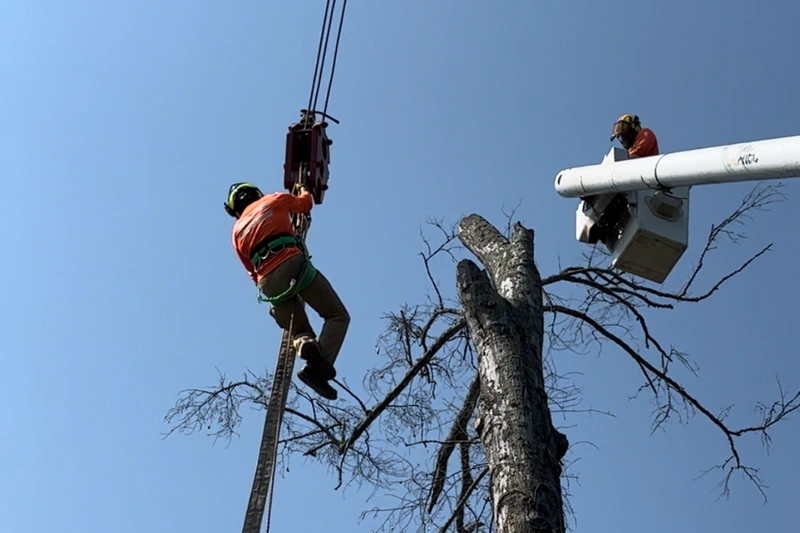
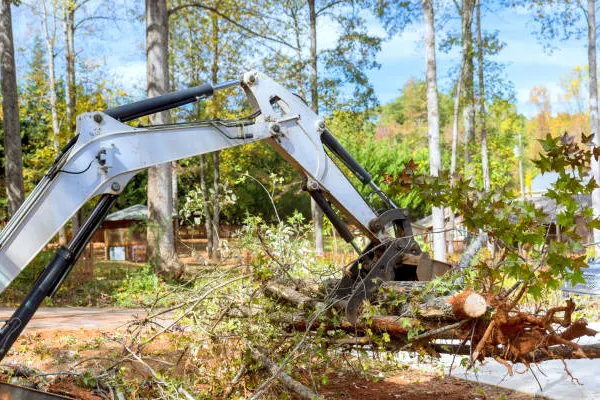
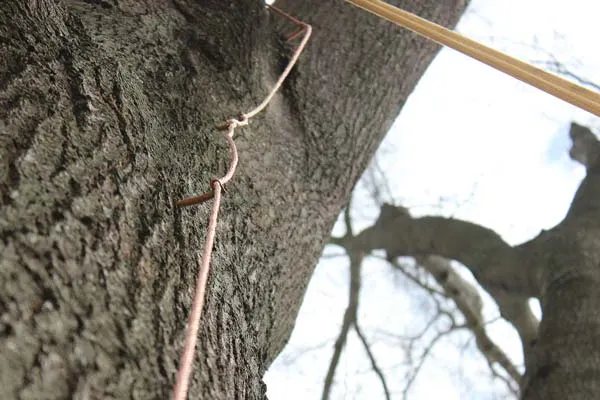
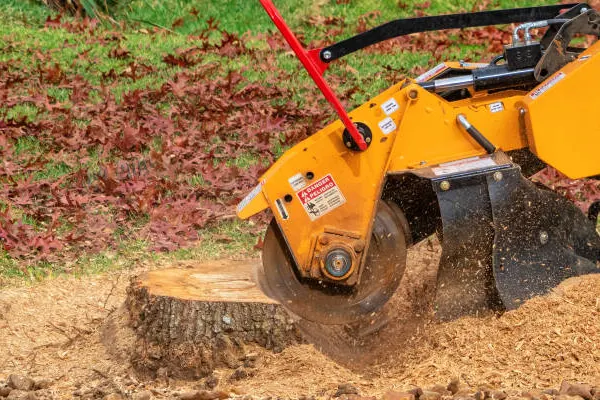


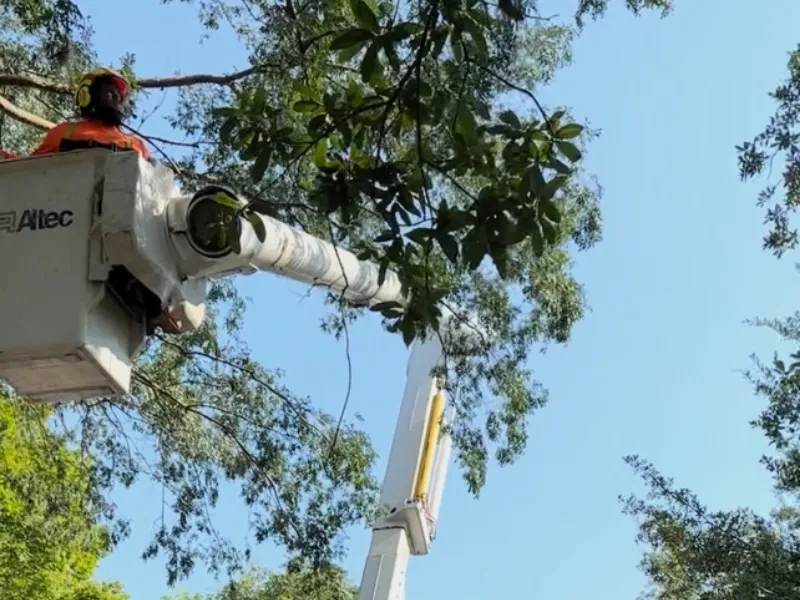
A 90-foot live oak leaning over a Spanish Town roof after a Tangipahoa-edge windstorm doesn’t have a climb-and-rig option. The wood doesn’t behave predictably, the lean is past the angle a climber can safely work, and the drop zone is the homeowner’s front bedroom. That’s a crane job, not because the price tag is bigger, but because nothing else is safe to attempt.
Most residential tree removals in Baton Rouge don’t need a crane. The work is straightforward, the climber can rig from the canopy, and the drop zone is the lawn. But the scenarios that do force a crane crew aren’t subjective, they trace to OSHA standards, ANSI Z133 safety practice, and structural decay criteria that aren’t negotiable. American Forestry Services operates the crane work that some Baton Rouge competitors can’t, and we wrote this post because half the homeowners who call after a crane recommendation aren’t sure if the recommendation is real or an upsell. Here’s how to tell.
A tree removal requires a crane when one or more of six conditions are present: the tree is taller than 80 feet, it leans more than 15° from vertical (or has a sudden/progressive lean indicating root failure), it sits within 20 feet of an energized power line up to 350 kV (50 ft above), the canopy is directly over a structure with no safe drop zone, the trunk shows structural decay (fruiting bodies, hollow wood, Ganoderma or Hypoxylon canker), or it’s a dead tree with brittle wood that won’t bear climber loads. The crane premium adds roughly $500 per day and complex jobs reach $6,000–$7,000 per Angi’s 2026 tree removal cost data, but the math still favors crane removal over a structure-damage claim or a worker injury.
TLDR:
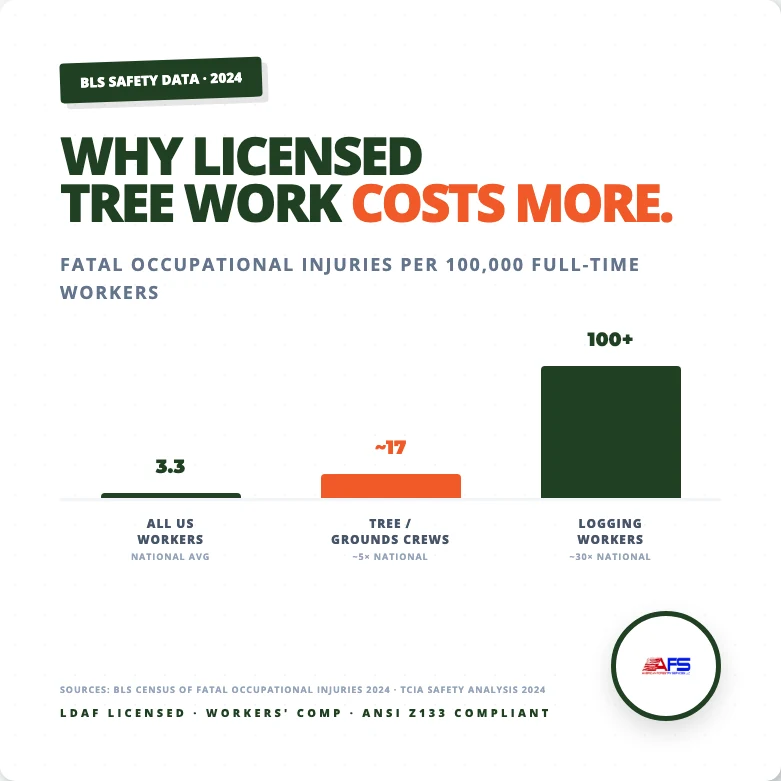
- Tree workers face one of the highest occupational fatality rates in the U.S., TCIA’s 2024 safety analysis reports 243 tree-care fatal injuries from 2020–2023 (about 61 per year) with the grounds-maintenance category running roughly five times the BLS all-industry fatality rate of 3.3 per 100,000.
- The 80-foot height threshold is the most common single trigger, Angi’s 2026 cost research confirms trees taller than ~80 ft typically require a crane.
- OSHA 29 CFR 1926.1408 mandates a 20-foot minimum approach distance for crane operations near energized power lines up to 350 kV (50 ft above), any tree close enough to the line to violate that envelope can’t be climbed-and-rigged either.
- Louisiana’s 110+ FEMA disaster declarations, most recently Hurricane Francine in 2024 (DR-4817-LA), keep post-hurricane uprooted-but-hung-up trees common, climbing one is categorically unsafe.
- Crane add: roughly $500/day on top of base removal; complex crane jobs reach $6,000–$7,000, still cheaper than a six-figure structure-damage claim or a workers’ comp incident.
When a Crane Is the Only Safe Option (The 6 Decision Criteria)
These six criteria are where a crane stops being a choice and becomes the only defensible approach. They’re the ones a Louisiana arborist crew checks first when they walk a property.
1. The Tree Is Taller Than 80 Feet
The single most common trigger. Angi’s 2026 cost data identifies the 80-foot threshold as the conventional point where crane crews take over from climb-and-rig crews. Above 80 feet, the climber working at the top has limited safe rigging options, the wood pieces being lowered weigh more than ground-based catchers can manage, and the time-on-tree exposure stretches into multi-day work. A crane reduces total time on the tree, lets the crew lift pieces away from the structure rather than rigging them down toward it, and keeps the climber out of the highest-risk segment of the canopy.
In Baton Rouge, the 80-foot rule comes into play more often than national averages suggest because the mature canopy in older neighborhoods is so heavy on live oak and pecan, both of which routinely exceed it.
2. Lean Greater Than 15° From Vertical (Or Sudden/Progressive Lean)
A standing tree’s lean tells you what the root plate is doing. Trees that lean more than roughly 15° from vertical are generally considered unsafe to climb, the angle changes how the trunk loads under a climber’s weight, and on heavy live oaks the lean can mask a partially failed root system. A sudden new lean after a wind event, or visible progressive lean over weeks, indicates root plate failure already in progress. Climbing a tree with an actively failing root system can complete the failure with the climber in it.
Post-hurricane is where this criterion fires repeatedly. After Laura, Ida, and Francine, Livingston Parish crews see leaning live oaks and pecans with visible soil heave on the opposite side of the lean, root plates lifted from the saturated soil. None of those are climb-and-rig jobs.
3. The Tree Is Within OSHA’s Power-Line Approach Distance
OSHA 29 CFR 1926.1408 mandates a 20-foot minimum approach distance for crane operations near energized power lines up to 350 kV, and 50 feet above 350 kV. The same physics that govern the crane envelope govern the climber: a tree close enough to a line that any part of the work or the lowered material can encroach within those distances requires either a coordinated outage with the utility, an insulated crane operation, or both. The OSHA 2021 tree care inspection guidance memo references ANSI Z133 throughout, the arboricultural safety standard that governs how this work has to be planned.
Translation for a Baton Rouge homeowner: if the tree is in front of your house close enough that the power drop runs through its canopy, a legitimate quote will include either a Entergy line-clearance coordination step or crane-with-insulation pricing. A quote that says “we’ll just be careful” is the upsell-by-omission version.
4. The Canopy Is Directly Over a Structure With No Safe Drop Zone
ANSI Z133-2017 §5.7.11 governs crane lifting of personnel and load-weight estimation in arboriculture, per the OSHA tree care inspection guidance. When the canopy is directly above a house, garage, pool, or fence, and the lot offers no clear drop zone the crew can rig material into, the crane is the only way to lift pieces away from the structure rather than risk dropping them onto it. A mistimed climber-rigged piece falling onto a shingle roof costs more than the entire crane day.
The signature Baton Rouge example: a 70-foot live oak straddling the property line behind a Garden District house. The canopy extends 40 feet over the kitchen and 30 feet over the neighbor’s driveway. There’s no clean drop zone on either side. The crane sets up in the street, picks pieces from above the canopy, swings them to a chip truck on the curb. Climb-and-rig would put bowling-ball pieces of live oak over both structures with every cut.
5. Structural Decay Visible in the Trunk
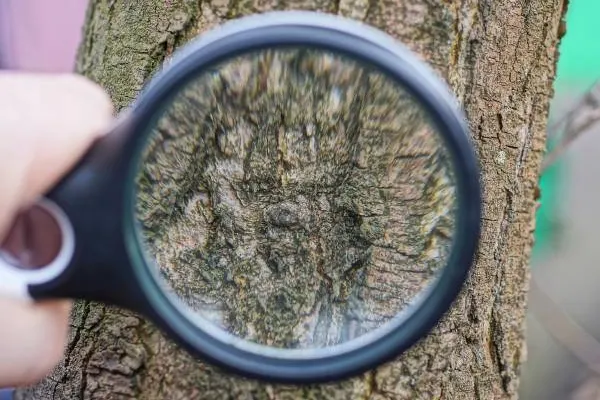
When a trunk shows fruiting bodies (mushrooms or conks at the base or along the bole), large open cavities, or evidence of internal decay fungi like Ganoderma, Hypoxylon canker, or Kretzschmaria, the wood cannot reliably bear climber loads or rigging forces. The tree can fail catastrophically at the decayed segment under load, meaning the climber rigging a piece down can ride the entire trunk to the ground when the decay zone gives. A crane removes the climber-on-trunk variable entirely; the pieces come off from outside, lifted clear, no internal trunk loading.
A Baton Rouge arborist walks the trunk and the root flare on every estimate. Visible decay isn’t a maybe. It’s a hard line.
6. Dead Trees With Brittle Wood
Dead trees are categorically more dangerous than live ones, and they cost more to remove, not less. Branches and trunk sections of standing dead trees can fail unpredictably during a climb because the wood has lost the elasticity that lets a live tree absorb the rigging shock. A crane provides external support, lets the crew remove pieces in sequence from the top, and keeps the climber off a structure that may fail under their weight at any point.
In Louisiana, the dead-tree scenario is most common with hurricane-damaged trees that didn’t come down but won’t survive, the wood is technically standing but is brittle, internally cracked, or already partially failed. Those are crane jobs every time.
When a Crane Is the Smarter Option (Even If Not Strictly Required)
Beyond the six hard criteria, three gray-area scenarios make a crane the practical right choice even when a climber could theoretically do the job.
Large DBH and “Grand Oak” status live oaks. Live oak wood is significantly heavier than most species. A 36-inch DBH live oak with a 70-foot spread has rigging loads at the upper end of what conventional rigging can handle safely. Pieces are heavier, swings are bigger, ground-based catchers are working at their limit. A crane shortens the day and brings the load math back to comfortable margins.
Tight access lots where conventional rigging would take multiple days. When the only way to climb-and-rig is to disassemble the tree piece-by-piece across two or three days, the cost of crew-days adds up faster than a single-day crane operation. The math often favors the crane even when the climb is technically possible.
Post-hurricane uprooted-but-hung-up trees. These are the Louisiana specials. A tree that came partially down in a storm but caught in another tree, or partially lifted from the soil but didn’t fall, is categorically more dangerous than a standing intact tree of the same size. The OSHA tree care inspection guidance flags hung-up trees specifically. A crane removes the unpredictable failure variable.
What’s Different About Louisiana Crane Work
Louisiana’s tree work has three Louisiana-specific stressors a national checklist won’t catch.
First, old-growth live oaks. The state’s tree, by statute, is dense and spreads wide. Specific gravity around 0.84 means cut pieces weigh substantially more than the equivalent volume of pine or maple. The mature live oaks lining Spanish Town, the Garden District, mid-city Baton Rouge, and the older blocks of Walker and Denham Springs routinely exceed both the 80-foot height threshold and the 30-inch DBH threshold that push a job into crane territory.
Second, the hurricane belt. Louisiana has been inside the federal disaster declaration footprint for 110+ FEMA-declared events, most recently Hurricane Francine in September 2024. Post-hurricane tree work, leaning trees, uprooted-but-hung-up trees, partial root failures, brittle storm-stressed wood, runs heavy in every Livingston Parish year. The base rate of “this needs a crane” climbs after every named storm.
Third, saturated soil. Days after a major rain or hurricane, soil saturation can drop the friction holding a marginal root plate by enough to make climber weight the deciding load. The “looks fine standing” tree on Tuesday becomes the failure-in-progress tree on Friday. Local crews check soil conditions; out-of-town storm chasers usually don’t.
The Cost Difference (Real Numbers)
The crane premium is real. Angi’s 2026 tree removal cost research places the crane add at roughly $500 per day on top of base removal pricing, with complex crane jobs reaching $6,000–$7,000 total. For the broader cost framework, see the Baton Rouge tree removal cost guide for 2026, this section is just the crane delta.
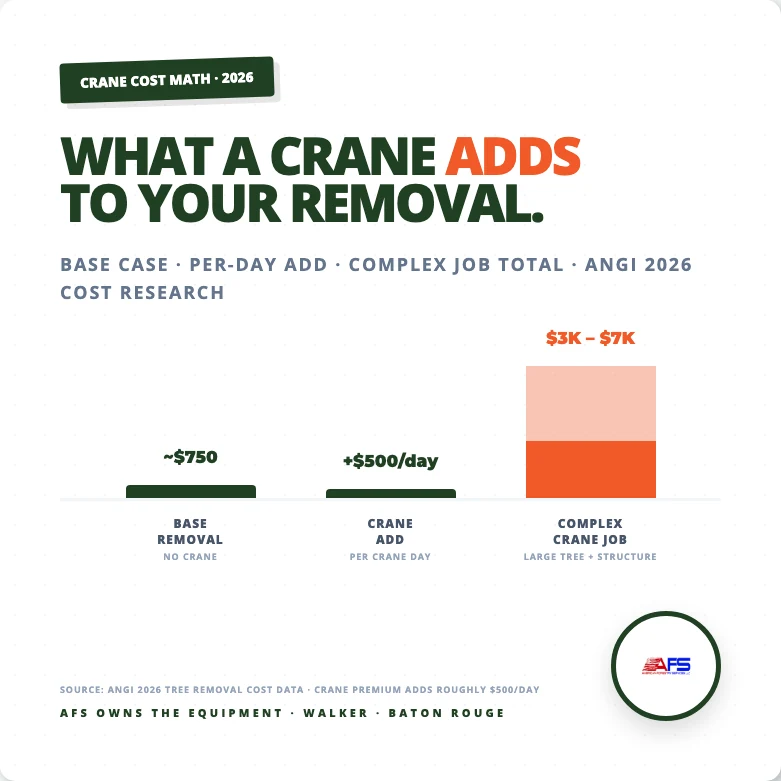
Two ways to read that math. First, the per-day add is smaller than most homeowners expect, $500 isn’t the difference between a $1,000 job and a $5,000 job. The difference comes from the complexity that triggered the crane in the first place (larger tree, longer day, more setup). Second, the cost of not using the crane when one is warranted is much larger than the crane premium: a $7,000 complex crane job versus a six-figure structure damage claim and a workers’ comp incident is the trade most Baton Rouge homeowners aren’t doing the math on.
How to Spot a Crane Upsell vs. a Legitimate Crane Recommendation
The same six criteria above are the diagnostic. If a quote includes a crane line item, ask which specific criterion triggered it. A real recommendation will name the criterion (height, lean angle, proximity to a line, decay indicators, canopy over structure, dead-tree status) and explain why climb-and-rig isn’t safe. An upsell will deflect to vague language about “being careful” or “doing it right.”
Five red flags that suggest the crane recommendation isn’t legitimate:
- No LDAF arborist license. Anyone offering fee-based tree work in Louisiana must hold a current LDAF Horticulture Commission arborist license. The license is checkable in one phone call.
- No proof of insurance. Workers’ comp and general liability are how the homeowner stays out of the claim when something goes wrong. Verbal assurances don’t count.
- No written estimate with line items. “It’ll be about $3,500 for the crane” is not an estimate. Real quotes name the line items: removal labor, crane day rate, debris haul-off, stump grinding if applicable.
- Door-to-door cold approach after a storm. Storm chasers from out of state work hurricane footprints aggressively. Most aren’t LDAF-licensed and aren’t carrying the insurance the work requires.
- “Decide today” pressure. A real arborist will give you time to verify credentials and get a second quote. Pressure tactics are the upsell tell.
Five green flags that suggest the recommendation is real:
- LDAF license number provided on request, BBB record clean, current insurance certificates available.
- Quote names which of the six criteria triggered the crane recommendation.
- ANSI A300 or ANSI Z133 references in the written work plan.
- Workers’ compensation coverage for the entire crew, not just the lead climber.
- Local business with a verifiable physical address (American Forestry Services is at 29980 Henderson Lane, Walker, for example).
What Happens on a Crane Tree Removal Day
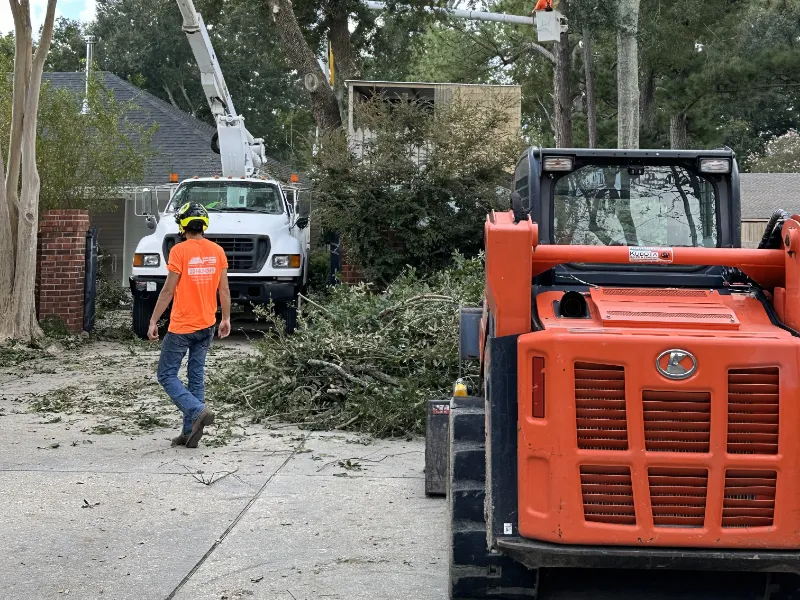
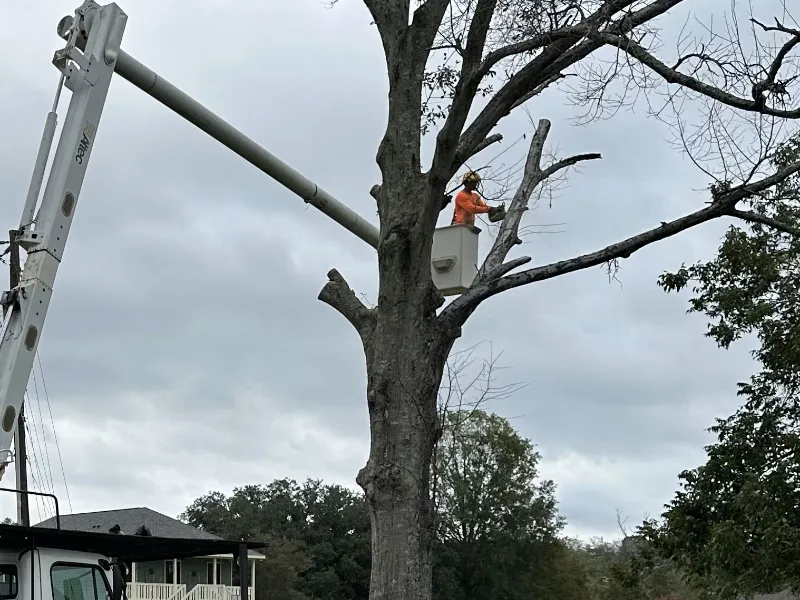
The shape of a typical AFS crane removal day: pre-work site assessment with the crane operator, drop-zone setup on the property side that takes the picks, OSHA approach-distance verification for any nearby power lines, crane positioning (usually street-side or driveway), pick planning by load weight per ANSI Z133, cuts from the top of the canopy down with each piece swung clear of the structure, ground crew handling and chipping pieces as the crane lowers them, debris staged and loaded at job completion. For straightforward jobs it’s a single-day operation; the complex cases run two days.
The crane services page covers the operational and equipment details. The point of the day’s setup is the same as the point of the six criteria: get the climber out of the highest-risk segment of the canopy, lift pieces away from the structure rather than rigging them toward it, and shorten total time on tree.
Common Questions About Crane Tree Removal in Baton Rouge
These are the questions Baton Rouge homeowners ask after a crane recommendation. Most center on three questions: is the price real, does insurance help, and can AFS actually access the property?
Why is a crane removal so much more expensive?
The crane itself costs to mobilize, position, and operate, roughly $500 per day adds to the base removal per Angi’s 2026 data. But most of the price difference on a complex crane job isn’t the crane line item. It’s the complexity that triggered the crane in the first place. Larger trees, longer days, structures to protect, and more setup all add cost independently. The crane premium itself is smaller than most homeowners assume.
Will my insurance cover crane work?
Same answer as standard tree removal: only if the tree fell on an insured structure due to a covered peril, and only up to the per-tree and aggregate caps in your policy. Preventive crane removal of a dead or hazardous tree before it falls is almost never reimbursed. For the broader insurance picture, see the Baton Rouge tree removal cost guide.
How long does a crane tree removal take?
A standard crane job on a single large tree typically runs one full day, including setup, pick sequence, and cleanup. Complex jobs with structure protection or multiple trees can run two days. Conventional climb-and-rig on the same tree often runs two to three days, so the day count is part of why the crane math sometimes works out comparable to a conventional removal.
Can the crane reach my backyard?
Depends on the lot. Most residential cranes used in arboriculture have telescoping booms with reach in the 70–110 foot range, so a crane positioned in the street or driveway can reach most Baton Rouge backyards. Tight subdivisions with no street access on the side facing the tree can be a problem, the on-site assessment is when the operator confirms the reach geometry.
Do you need a permit to operate a crane in a residential neighborhood?
For typical residential tree work, no, the crane operates on the homeowner’s property or in the abutting public right-of-way under temporary lane closure if needed. A crane setup that closes a city street requires coordination with the relevant municipal traffic engineering office; AFS handles that step directly when applicable. For the broader question of when tree removal itself requires a permit, see the Baton Rouge tree removal permit guide.
Is AFS the only crane operator in Baton Rouge?
No, but it’s a short list, and a couple of the metro’s other operators run light-duty cranes that aren’t rated for the large live oak work the criteria above describe. American Forestry Services owns and operates the equipment for the full range of residential and commercial crane removals across Walker, Baton Rouge, Denham Springs, Livingston Parish, and surrounding municipalities.
Crane removal estimate from a Walker-based arborist.
If you’ve been quoted a crane price and aren’t sure it’s the right call, or you’ve got a leaning live oak over your house and need someone who actually owns the equipment, get a real on-site assessment from American Forestry Services. Same-day quotes available when scheduling allows.
Call or text (225) 955-0369 for a free on-site estimate.