


The question comes up almost every week: “Can I just take down the dead pine in my backyard, or do I need a permit?” The short answer for most Baton Rouge homeowners is no, and that surprises people who’ve been told otherwise by a tree service quoting “permit handling” as a $300 line item. The longer answer has four exceptions, two state-level rules that always apply, and a layer of HOA covenants that the city has nothing to do with.
American Forestry Services has handled tree work across Walker, Baton Rouge, Denham Springs, Livingston Parish, and the surrounding municipalities for two generations. This guide is what we wish every homeowner knew before they assumed a permit was required (or not) for the tree in their yard.
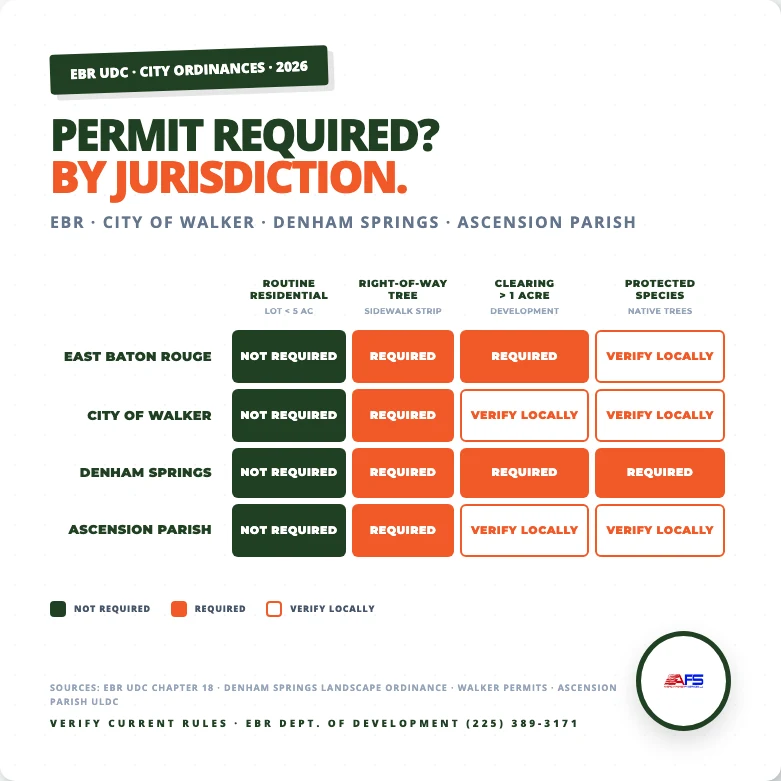
Most routine residential tree removals in Baton Rouge do not require a city permit. The East Baton Rouge Parish Unified Development Code’s Chapter 18: Landscape and Trees governs the rules, and the Land Clearing Permit requirement explicitly excludes individual residential lots under 5 acres in a recognized subdivision. Four scenarios change the answer: (1) the tree is in the public right-of-way, (2) you’re clearing more than one acre or redeveloping the lot, (3) the tree is a protected native species, or (4) an HOA covenant requires approval. When in doubt, call the EBR Department of Development at (225) 389-3171 before any removal.
TLDR:
- For most single-family residential lots under 5 acres in EBR, the city does not require a permit for routine tree removal, confirmed in the EBR Land Clearing Permit requirements document.
- A Land Clearing Permit ($100 review fee, SWPPP approval required) is required for any disturbance over one acre or any redevelopment.
- Trees in the public right-of-way are public property regardless of which house’s yard they’re next to, removal requires city permission. The City of Denham Springs Landscape Ordinance states this principle explicitly, and most Louisiana municipalities follow the same logic.
- Louisiana Civil Code Article 2317.1 holds property owners liable for damage from defective trees they knew or should have known about, so even when no permit is required, an inspected and documented tree is the legal protection.
- Anyone doing fee-based tree work in Louisiana must hold a current LDAF Horticulture Commission arborist license, a statewide layer that applies regardless of the city permit requirement.
The Short Answer for Most Baton Rouge Homeowners
For a homeowner removing a single tree (or several) on a residential lot under 5 acres in a recognized East Baton Rouge subdivision, no city permit is required. That’s straight from the EBR Land Clearing Permit requirements, which explicitly carve out individual existing residential lots from the Land Clearing Permit requirement.
The framework that governs tree work in EBR lives in Chapter 18: Landscape and Trees of the Unified Development Code. The chapter sets the rules for tree preservation, landscape requirements during development, and the conditions under which removal of certain trees does require permitting. Most of those conditions don’t apply to a homeowner taking down a dead or hazardous tree on their own property, the chapter is primarily about development work and significant land disturbance.
What this means in practice: you can call a licensed arborist, get an estimate, and schedule the work without filing anything at city hall. The four exceptions below are where that simple answer changes.
When You DO Need a Permit (The 4 Scenarios)
1. The Tree Is in the Public Right-of-Way
Trees growing between the sidewalk and the curb, in the neutral ground of a divided street, at the edge of a public road, or in any other space that’s technically public property are not the homeowner’s tree to remove, even if the trunk is 18 inches from the property line. Removing one without authorization is unauthorized work on public property, and the principle applies across Louisiana municipalities.
The City of Denham Springs Landscape Ordinance (Chapter 78, Article III) states the rule plainly: “No person, except as authorized under permit of the city or other governing utility, shall cut or otherwise remove any living tree on public right-of-way, neutral ground, public park, sidewalk, or other public property of the city.” Other municipalities use slightly different language to say the same thing.
American Forestry Services handles right-of-way removals when they’re necessary by coordinating directly with the relevant city public works office, Baton Rouge, Walker, Denham Springs, or whichever jurisdiction owns the tree. Don’t take a right-of-way tree down without that coordination; the penalty for unauthorized removal of a public-property tree is meaningful and not worth it.
2. You’re Clearing More Than One Acre
The EBR Land Clearing Permit is required for any land disturbance exceeding one acre, or any redevelopment of a parcel. The $100 review fee covers the application; a Stormwater Pollution Prevention Plan (SWPPP) approval is part of the package. The accompanying Land Clearing Requirements documentation further specifies that tree protection fencing must be installed prior to clearing and site work, failure to install the fencing can suspend work mid-project.
The Land Clearing Permit is essentially a development-side requirement, not a homeowner-side requirement. If you’re a single-family homeowner removing one or two trees from your yard, you don’t trigger it. If you’re a developer clearing a 2-acre subdivision lot or a contractor preparing a commercial parcel for construction, you do.
3. The Tree Is a Protected Native Species
EBR Chapter 18 protects certain native trees once they reach specific size thresholds, the protected species list and the exact DBH (diameter at breast height) thresholds are part of the chapter and subject to periodic UDC amendments. Because the specific thresholds change with amendments, verify with the EBR Department of Development at (225) 389-3171 before removing any mature live oak, pecan, cypress, or other significant native specimen tree.
A few principles apply regardless of the current threshold numbers. Live oaks tend to receive heightened protection across Louisiana municipalities given their cultural and ecological status, Louisiana’s state tree, with mature specimens routinely 200+ years old. Tree work on heritage live oaks in Spanish Town, the Garden District, mid-city Baton Rouge, and similar historic-canopy neighborhoods is the most common scenario where the protected-species question kicks in. The cost framework for live oak removal sits inside the Baton Rouge tree removal cost guide, but the permit question precedes the cost question, confirm the regulatory status before scheduling the work.
4. Your HOA or Subdivision Covenant Requires Approval
This is the one most homeowners forget. Even when EBR doesn’t require a city permit, many Baton Rouge-area subdivisions have deed restrictions or architectural review committees that do require approval for tree removal. Some covenants are aggressive (any tree over a certain size requires the ARC’s written consent); others apply only to street-frontage trees.
The city’s “no permit needed” answer doesn’t override a private covenant. If you remove a tree your HOA covenant required approval for, the penalty isn’t a city fine. It’s a homeowner-association action that can include required replanting, fines, or in extreme cases a lien on the property. Check the covenant before scheduling the work, and call the HOA or ARC chair if the language is ambiguous.
What Happens in Other Parishes (Livingston, Walker, Denham Springs, Ascension)
The four Baton Rouge-metro jurisdictions handle tree-removal permitting in slightly different ways. American Forestry Services operates across all four, and the local nuances matter when scheduling work.
Livingston Parish + City of Walker
American Forestry Services is HQ’d in Walker, 29980 Henderson Lane, in the heart of Livingston Parish. The City of Walker building permits framework governs structural work in the incorporated city; tree work on public property requires city permission, but private-property residential tree removals on standard lots generally do not require a Walker city permit. Unincorporated Livingston Parish defaults to the parish permits framework, same general principle: routine residential removals don’t require a parish permit, but development-scale clearing and right-of-way work do.
What this means for a Livingston Parish homeowner: the answer is “no permit needed” for most yard trees, but verify with the City of Walker or the Parish before removing anything in a subdivision common area, on a corner lot’s right-of-way frontage, or any tree in the public ROW of LA-1019, LA-447, or any other state route through the parish.
City of Denham Springs
The clearest published municipal ordinance in the area is the City of Denham Springs Landscape Ordinance (Chapter 78, Article III). The ordinance explicitly requires a “Protected Tree Removal Permit” prior to removal or land clearing for native trees of significant size, requires a permit for clearing any tract of one acre or more, and prohibits anyone, except a permitted utility, from cutting or removing living trees on the public right-of-way, neutral ground, public park, sidewalk, or other public property of the city. Denham Springs is the parish municipality most likely to require a permit for a borderline case; verify locally on any removal involving a mature tree or a property near a city street.
Ascension Parish
Ascension Parish tree and landscape rules live in the Unified Land Development Code on Municode. Like EBR, the parish takes a development-side approach: land clearing, redevelopment, and public-ROW work require permits, while routine residential removals generally don’t. The Municode index is the canonical source; the parish development office can confirm a specific case.
Louisiana State Law That Always Applies (Even When There’s No Permit)
Two state-level rules apply regardless of which parish you’re in or if the city requires a permit for the specific tree.
Louisiana Civil Code Article 2317.1: Why a Dead Tree Is Your Liability Problem
Louisiana Civil Code Article 2317.1 governs the legal liability of property owners for damage caused by things in their custody, including trees. The statute holds the owner liable only on a showing that they knew or should have known of the defect, that the damage was preventable, and that they failed to use reasonable care.
Translation: a dead or visibly defective tree on your property that you knew about and didn’t address creates a documented liability. If that tree falls on a neighbor’s car, a neighbor’s fence, or a passerby, your homeowner’s insurance adjuster’s first question is going to involve 2317.1 and if you can demonstrate reasonable care, which generally means a documented arborist inspection, a documented decision to remove or stabilize, and either acting on it or recording why you didn’t. An ISA-certified or LDAF-licensed arborist’s written assessment is the documentation that matters.
EBR also publishes a resident-facing reference document on the Louisiana Civil Code for trees on private property, which covers neighbor disputes, overhanging branches, and the limits of city authority. The EBR FAQ makes it explicit: the city-parish has no authority to intervene in neighbor tree-limb disputes, those are civil matters between property owners.
LDAF Arborist Licensing: Who’s Allowed to Do the Work
Even when no city permit is required, the person doing the removal must hold a current arborist license issued by the Louisiana Department of Agriculture and Forestry Horticulture Commission if they’re being paid. The license requires a passed exam, current insurance, annual continuing education, and a $125 annual fee. It applies to anyone offering tree removal, pruning, cabling, fertilization, or cavity work for compensation in Louisiana.
Practical translation: the door-to-door storm chaser quoting cash for a Saturday job almost certainly isn’t licensed. Verifying the LDAF license is a one-minute call to the state and the single fastest way to filter legitimate tree services from operators working outside the regulatory layer. American Forestry Services holds the LDAF license, BBB accreditation (A+ since September 2024), and current workers’ compensation and general liability coverage, and we’d verify the same for anyone you’re considering.
Why Some Tree Service Companies Tell You “You Need a Permit” When You Don’t
The permit ambiguity is sometimes used as an upsell. An operator quotes “$300 for permit handling” on a routine residential removal that doesn’t require a permit, and the homeowner pays for paperwork that doesn’t exist.
Two questions disarm the upsell. First: which section of EBR UDC Chapter 18 or the city ordinance requires this permit? A real answer cites a specific section. A bluff deflects to vague language. Second: what’s the permit fee the city is charging? The Land Clearing Permit costs $100 to file; routine residential tree removal in EBR has no permit fee because there’s no permit. If the quote includes a $200 “permit fee” with no corresponding receipt from the city, the line item isn’t going to the city.
What American Forestry Services Does on a Permit-Required Job
When a permit is genuinely required, typically right-of-way work, clearing more than an acre, or a protected-species removal, American Forestry Services handles the application directly. The workflow looks like this: confirm the specific rule with the relevant city or parish department, file the appropriate permit application (Land Clearing Permit or right-of-way work authorization or protected-species removal authorization), schedule the work around the city’s approval timeline, and execute the removal in compliance with whatever conditions the permit imposes (tree protection fencing, replanting requirements, debris management plans).
The homeowner doesn’t deal with the municipal paperwork. Whatever the city or parish requires is handled as part of the work scope. For the broader picture of professional tree removal services and what AFS does on a typical residential removal, the service page covers the full operational scope.
Common Questions About Tree Removal Permits in Baton Rouge
These are the permit questions Baton Rouge and Livingston Parish homeowners ask before booking work. Several center on edge cases, dead trees, right-of-way trees, HOA covenants, and how AFS handles permit-required jobs across the metro service area.
Do I need a permit to remove a dead pine in my backyard?
For a single-family residential lot under 5 acres in EBR, no. The EBR Land Clearing Permit requirements explicitly carve out individual existing residential lots from the clearing-permit requirement, and a dead pine doesn’t typically fall into the protected-species category. The work still needs to be done by an LDAF-licensed arborist, but no city permit applies.
Are live oaks specially protected in Baton Rouge?
Live oaks generally receive heightened protection across Louisiana municipalities given their cultural and ecological status, and EBR Chapter 18 addresses protected native trees. The specific size thresholds and species list are subject to UDC amendments, so before removing a mature live oak, verify the current rules with the EBR Department of Development at (225) 389-3171.
What’s the fine for removing a tree without a required permit?
Fine amounts vary by jurisdiction and by the specific violation (unauthorized clearing, removal of a protected tree, removal of a right-of-way tree), and the city or parish updates the schedule from time to time. Don’t take a quoted fine figure from a tree service or a blog post, call the EBR Department of Development at (225) 389-3171 for the current penalty structure in EBR, or the relevant municipality for Walker, Denham Springs, or Ascension Parish jurisdictions.
The tree is in front of my house but between the sidewalk and the curb, whose tree is it?
That’s a public right-of-way tree, and it belongs to the city even though it’s directly in front of your property. Removal requires city authorization. The Denham Springs Landscape Ordinance names this rule directly; EBR follows the same principle. American Forestry Services coordinates right-of-way removals with the relevant public works office when they’re necessary.
Does my HOA’s rule override the city’s “no permit needed” answer?
The HOA’s rule doesn’t override the city, but the city’s rule doesn’t override the HOA either. They’re separate layers. The city may not require a permit, and the HOA may require approval, both can be true at once. Check your subdivision covenant before scheduling any tree work; the penalty for violating an HOA covenant is enforced through the homeowner association, not the city, but it can be substantial.
AFS isn’t based in Baton Rouge proper, do you still handle permit work in EBR?
Yes. American Forestry Services is HQ’d in Walker (29980 Henderson Lane) but operates throughout the Baton Rouge metro service area, including EBR Parish, and handles permit applications and right-of-way coordination as part of the normal work scope. The Walker headquarters location actually helps on Livingston Parish work where the local knowledge of LA-1019, LA-447, and the unincorporated subdivisions matters.
Need to know if your tree needs a permit before you book the work?
Save yourself the call to EBR. American Forestry Services holds the LDAF arborist license, knows the Chapter 18 framework, and handles the permit work directly when it’s needed, across Walker, Baton Rouge, Denham Springs, Livingston Parish, and the surrounding service area.
Call or text (225) 955-0369 for a same-day assessment when scheduling allows.